In today’s digital-first world, our eyes are under constant strain. In both the United Kingdom and the United States, public health data highlights a significant increase in both chronic eye conditions and lifestyle-related vision fatigue. Whether you are searching for symptoms of cataracts, looking for dry eye syndrome treatment, or trying to understand how to improve vision naturally, staying informed is the first step toward long-term eye health.
This article provides a comprehensive overview of the most searched and prevalent eye conditions in 2026, helping you navigate the complexities of modern eye care.
1. Digital Eye Strain (Computer Vision Syndrome)
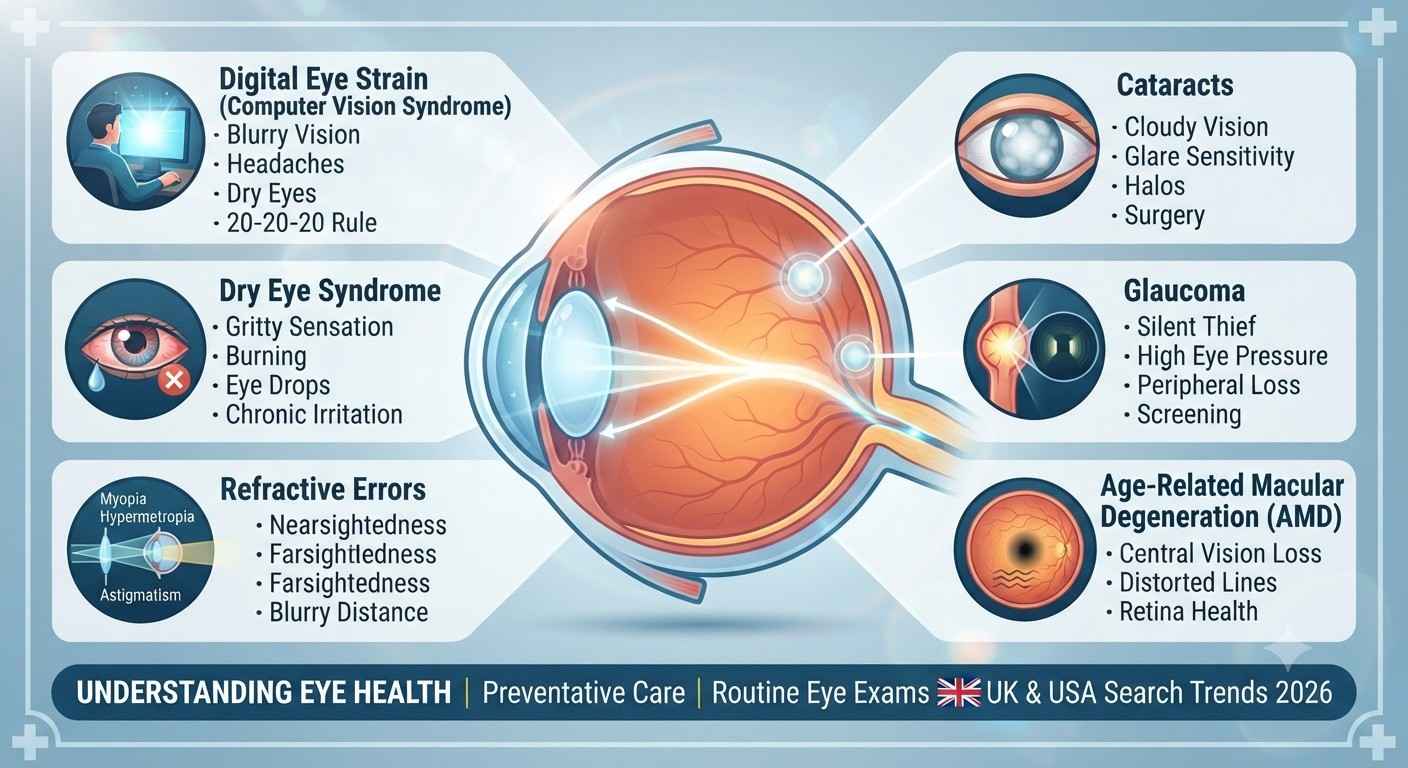
With the rise of remote work and extended screen time, digital eye strain—often searched as computer vision syndrome—has become one of the most common complaints in 2026.
- Symptoms: Blurry vision, headaches, dry or burning eyes, and neck or shoulder discomfort.
- Management: To combat this, eye care professionals recommend the 20-20-20 rule: Every 20 minutes, look at something 20 feet away for at least 20 seconds. Personalized lens options and blue-light filtering are also increasingly popular solutions for those spending hours in front of digital displays.
2. Dry Eye Syndrome
What was once considered a minor annoyance is now recognized as a chronic, often debilitating condition. Dry eye syndrome symptoms—such as a gritty, burning sensation or excessive tearing—frequently lead people to search for best eye drops for dry eyes or chronic dry eye treatment.
- Causes: Environmental factors, reduced blinking during screen use, contact lens wear, and hormonal changes.
- Treatment: Modern approaches go beyond simple over-the-counter drops, focusing on identifying the underlying cause, including lifestyle adjustments and prescription therapies like Lifitegrast or Cyclosporine.
3. Age-Related Eye Conditions
As the population ages in both the US and the UK, three specific conditions remain the leading causes of visual impairment:
Cataracts
A cataract is a clouding of the eye’s natural lens. It is one of the most searched topics related to blurred vision and night blindness.
- Key Indicators: Faded colors, sensitivity to glare, and “halos” around lights.
- Solutions: While lifestyle changes can help in the early stages, cataract surgery remains a highly effective, standard procedure to restore clear vision.
Glaucoma
Often called the “silent thief of sight,” glaucoma causes damage to the optic nerve, frequently linked to high eye pressure. Because early stages are often asymptomatic, glaucoma screening is a critical topic in public health discussions.
- Risk Factors: Family history is a major indicator; individuals with a relative who has glaucoma are up to ten times more likely to develop it.
- Management: Regular tonometry (pressure measurement) is essential for early detection.
Age-Related Macular Degeneration (AMD)
AMD affects the central part of the retina, responsible for sharp, central vision. It is a primary concern for adults over 50.
- Types: There is “Dry” AMD (more common, gradual) and “Wet” AMD (less common, but more severe and sudden).
- Symptoms: Distorted straight lines, dark spots in the center of vision, and blurriness.
4. Refractive Errors
Refractive errors continue to be the most common reason for vision correction. These include:
- Myopia (Nearsightedness): Increasing rapidly among children and teenagers due to prolonged “near-work” and less time spent outdoors.
- Hypermetropia (Farsightedness): Difficulty focusing on close-up objects.
- Astigmatism: A common condition causing distorted or blurred vision at all distances.
- Presbyopia: The age-related loss of near-focusing ability, commonly managed with reading glasses or progressive lenses.
5. Other Frequent Eye Concerns
Beyond the major chronic diseases, people frequently search for information on:
- Conjunctivitis (Pink Eye): Often linked to allergic, bacterial, or viral causes. Symptoms include redness, itching, and discharge.
- Eye Floaters: Small specks or “strings” in your vision. While usually harmless, sudden increases in floaters or flashes of light can be a sign of retinal detachment and require immediate medical attention.
- Uveitis: Inflammation of the eye’s middle layer, often causing pain, redness, and light sensitivity.
The Importance of Routine Eye Exams
In 2026, the consensus among medical professionals in the UK (NHS) and the USA is clear: regular eye exams are the best preventive measure. An eye exam does more than update your prescription; it acts as a window into your overall health. Optometrists can often detect early signs of:
- Diabetes (Diabetic Retinopathy)
- High blood pressure
- High cholesterol
- Neurological conditions
Summary Table: Quick Reference for Common Symptoms
| Condition | Primary Symptoms |
| Digital Eye Strain | Headaches, burning eyes, blurred vision |
| Dry Eye | Gritty sensation, redness, stinging |
| Cataracts | Cloudy vision, glare sensitivity, halos |
| Glaucoma | Peripheral vision loss, tunnel vision |
| AMD | Distorted central vision, dark spots |
| Conjunctivitis | Redness, discharge, itching |
Conclusion
Whether you are dealing with eyestrain from your laptop or concerns about age-related vision loss, the takeaway is simple: do not ignore changes in your sight. Preventive care, such as wearing UV-protective sunglasses, maintaining a diet rich in antioxidants (vitamins A, C, and E), and scheduling routine check-ups, can significantly lower your risk of long-term vision impairment.
If you are experiencing persistent eye pain, sudden vision loss, or flashes of light, seek professional medical advice immediately. Your eyes are irreplaceable—protect them with proactive, informed care.
Disclaimer: This article is for informational purposes only and does not constitute medical advice. Always consult with a licensed eye care professional or ophthalmologist regarding your specific eye health concerns.
Follow-up Question: Are you asking because you or someone you know is currently experiencing specific symptoms that you would like to understand better?